
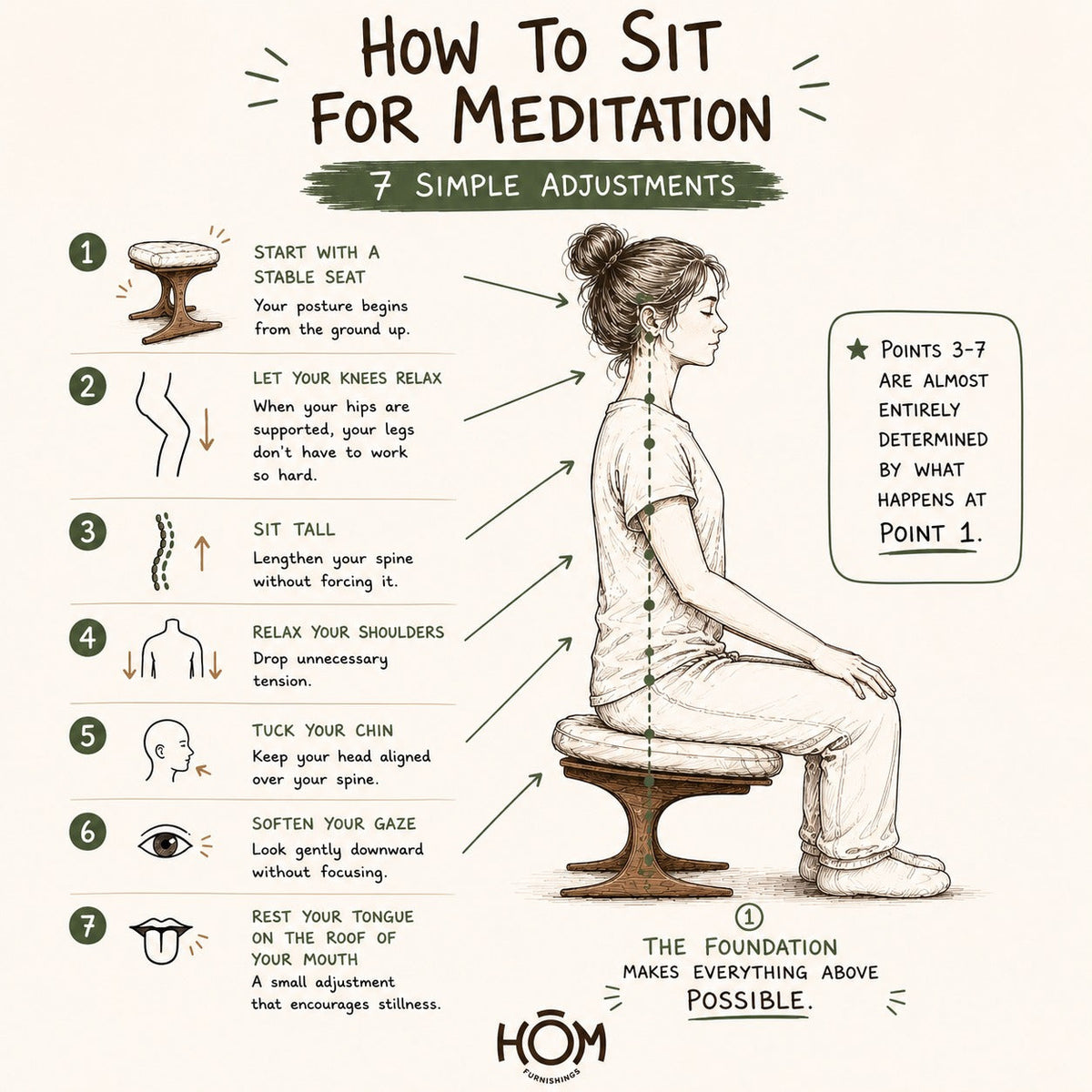
Working Within the Limits of the Body: The 7-Point Meditation Posture
For centuries, contemplative traditions have converged on a remarkably consistent idea: that how you sit shapes how you sit with your mind. The body is not a backdrop to meditation — it's the instrument. A settled body is the first condition for a settled mind, and everything that follows depends on getting that foundation right.
What follows is a posture recognized across traditions, distilled into seven points. Think of it less as a checklist and more as a single, connected gesture of the whole body toward stillness.

The Seven Points of Proper Posture
1. Grounded Seat. A settled body is the first condition for a settled mind. Before anything else, the seat must feel rooted and at ease — weight distributed evenly, the base of the body in full, unhurried contact with its support. This is the point everything else rests on, both literally and figuratively. When the seat is genuinely grounded, the body stops bracing and quietly hands over the work of holding itself up. That release is what lets attention turn inward instead of staying busy with balance.
2. Hands at Navel. Let the hands be still. What the body releases, the mind follows — and the hands, resting quietly near the navel, are where much of our restlessness first shows up. Cradled low and close to the center, with one resting in the other, the arms can let go of the small effort of holding. The shoulders soften as a result, and the whole front of the body settles. There's a reason traditions place the hands here rather than on the knees: it draws the body toward its own midline, gathering scattered energy into one quiet point.
3. Erect Spine. Alertness lives in the upright body. A spine that collapses invites dullness; a spine that lifts keeps the mind awake. The image traditions often use is a stack of coins — each vertebra resting lightly on the one below, the whole column tall but not stiff. The aim is uprightness without rigidity: lifted from the crown, soft through the ribs. Held this way, the spine costs almost nothing to maintain, because it's balanced rather than braced. And the quality of the body carries directly into the quality of attention — an awake spine makes for an awake mind.
4. Shoulders Open. Release the holding we carry in the body. The breath needs room to move freely, and open shoulders give it that room. Most of us live with a subtle, habitual rounding forward — drawn from desks, screens, and the small braces of daily life. Letting the shoulders roll gently back and down opens the chest and frees the diaphragm to move fully. The breath deepens on its own, without being managed. There's an evenness to this point worth noticing: open, but not pulled back into a military stance. Broad and relaxed, like a yoke resting easily across the back.
5. Chin Tucked. Gently align the head with the spine. This subtle adjustment is the posture of someone who is awake and attentive, not slumped or straining. The head is heavy, and where it sits changes everything beneath it — let it drift forward and the neck takes up the strain; let it tip back and the throat tightens. Drawing the chin in slightly settles the skull directly over the spine, so the long muscles of the neck can finally rest. The movement is small, almost private. Done well, it feels less like an instruction and more like the natural resting place the head was looking for all along.
6. Soft Gaze. Open to the world without being taken by it. A soft, lowered gaze is the middle way of the senses — neither shut tight nor pulled outward. Many traditions favor eyes half-open, lids lowered, the gaze resting on the floor a few feet ahead without fixing on anything in particular. Closing the eyes fully can invite drowsiness and daydream; opening them wide invites distraction. The soft gaze holds the balance between them, letting the world remain present without demanding a response to it. It's a small rehearsal of the larger practice: aware of everything, grasping at nothing.
7. Tongue at Palate. Rest the tongue lightly at the roof of the mouth, just behind the front teeth. Quieting these small, almost invisible movements deepens the stillness already settling through the body. It's the most overlooked of the seven points, and the most telling — the tongue is rarely still, constantly shifting with the silent stream of inner talk. Letting it rest in one place softens the jaw, slows the swallow reflex, and tends to quiet the mental chatter that rides along with it. This is the final refinement: stillness in the body deepens stillness in the mind, all the way down to its smallest gestures.
Here's the key insight that ties them together: points 3 through 7 are almost entirely determined by what happens at point 1. Get the seat right, and the spine, shoulders, chin, gaze, and breath tend to fall into place on their own. The foundation does most of the work.
The Problem: Bodies As They Are
The traditional ideal asks for the knees to rest below the hips. For many of us, that's genuinely difficult — and it's not a matter of discipline or willpower. It's anatomy.
When we sit at the very edge of our flexible range, a few things tend to happen. Part of a leg may begin to fall asleep. Tension creeps in. And to compensate for that tension, we quietly adjust the spine — which is exactly the foundation we were trying to keep steady. The pursuit of the ideal posture ends up undermining it.
The question, then, isn't how to force the body into a shape it can't comfortably hold. It's how to achieve comfortable alignment with our bodies as they are.
The Chain Reaction — Both Ways
Posture is a chain, and it runs in both directions.
Without support, here's what tends to go wrong. When the hips sit too low relative to the knees, the pelvis tilts backward. That backward tilt flattens the natural curve of the lower back, and from there a chain reaction travels up the entire spine. The collapse at the base becomes a collapse all the way to the head.
With the right seat, the chain reverses. The pelvis returns to a gentle forward (anterior) tilt. The natural lumbar curve comes back. And once the base is restored, everything above it falls into place — the spine, the shoulders, the head — without effort or correction.
This is why the seat matters more than any single instruction about the upper body. Fix the foundation, and you're no longer fighting your own spine.
The Seat
The HŌM meditation chairs are designed to alleviate pressure points and allow for natural alignment. Three elements do the work:
Wing supports cradle the upper thigh, reducing hip compression and joint fatigue — so the legs can settle without parts of them falling asleep.
Rocker feet let you adjust pelvic tilt, tuning the angle to your own body in moments rather than wrestling with it. You find your optimal position quickly and simply rest there.
Seat width and height establish the hip-above-knee geometry that is the foundational condition for the natural lumbar curve to return on its own.

One Seat. Three Positions. One Session.
A good seat doesn't lock you into a single posture. It supports the way the body actually wants to move through a sitting.
Cross-legged is the primary mode. The wings support the thighs, and the rocker is dialed in to your body.
Hybrid brings the legs partially underneath — no knees required on the floor — for those who want a different distribution of weight.
Japanese / kneeling tucks the legs fully under, with an optional bolster at the knees for comfort.
The point is that you can cycle through all three within a single session without ever losing postural integrity. The foundation holds, whatever your legs are doing.
Posture isn't about perfection. It's about giving the body the conditions it needs to be still — so the mind has somewhere settled to rest.
Explore HoM meditation chairs for comfortable, elevated cross-legged seating.